





COB vs SMD LED Lights for Video: How to Choose
Choose a COB light when you want one clean shadow, a Bowens mount and a beam you can shape with reflectors. Choose an SMD-style panel when you want wide, soft light from a slim body with little setup. Neither one has better colour just because of its LED package. Colour comes from the spectrum, so read the TLCI and SSI numbers.
If you want the soft-versus-hard basics, read our guide on LED panels vs Fresnels. This article goes one level deeper. It looks at the light source itself, what you can bolt on, and how much beam control you really get.
| COB point-source light | SMD-style LED panel | |
|---|---|---|
| Light source | Many bare chips under one phosphor layer | Many separate LED packages across a board |
| Bare light | Small source, defined shadow edge | Wide, soft spread |
| Modifiers | Usually full-size Bowens mount | Often the maker’s own clip-on softbox, grid or barn doors |
| Beam control | Reflectors, domes, projection lenses | Mostly built into the panel |
| Best for | Key and accent lights, softboxes, spotlight effects | Interviews, streams, small rooms, wide fills |
What actually differs inside the light
An SMD LED is a small, individually packaged part. The package holds one die, or a few. A panel solders dozens or hundreds of them onto a board.
A COB LED does it the other way round. It bonds many bare dies onto one substrate and covers them with a single phosphor layer. Nichia, an LED maker, says that multiple SMD LEDs in a spotlight can cast multiple shadows. One COB LED avoids that.
Why does this matter on set? Each separate emitter can throw its own shadow edge. On a bare panel, you may see a soft double edge under a chin or around a mic arm. A COB light gives you one source and one shadow.
Be careful with the labels, though. Most panels have a diffusion layer, so the multi-shadow effect is often hidden. And a COB light is not always a hard source. Put it in a softbox and it behaves like any other large soft source.
COB is also not a quality guarantee. The standards that rate colour look at the light’s spectrum, not the chip layout. Judge each light by its published numbers.
Modifiers: what you can attach
This is where the two designs feel most different in daily work.
Most COB video lights have a full-size Bowens mount. The amaran COB 60x S, for example, lists the Light Box 45×45, Light Dome SE and Aputure Lantern as compatible. You can swap softboxes, domes, reflectors and lenses from several brands. Hang a lantern on it and you get a round soft source for a room.
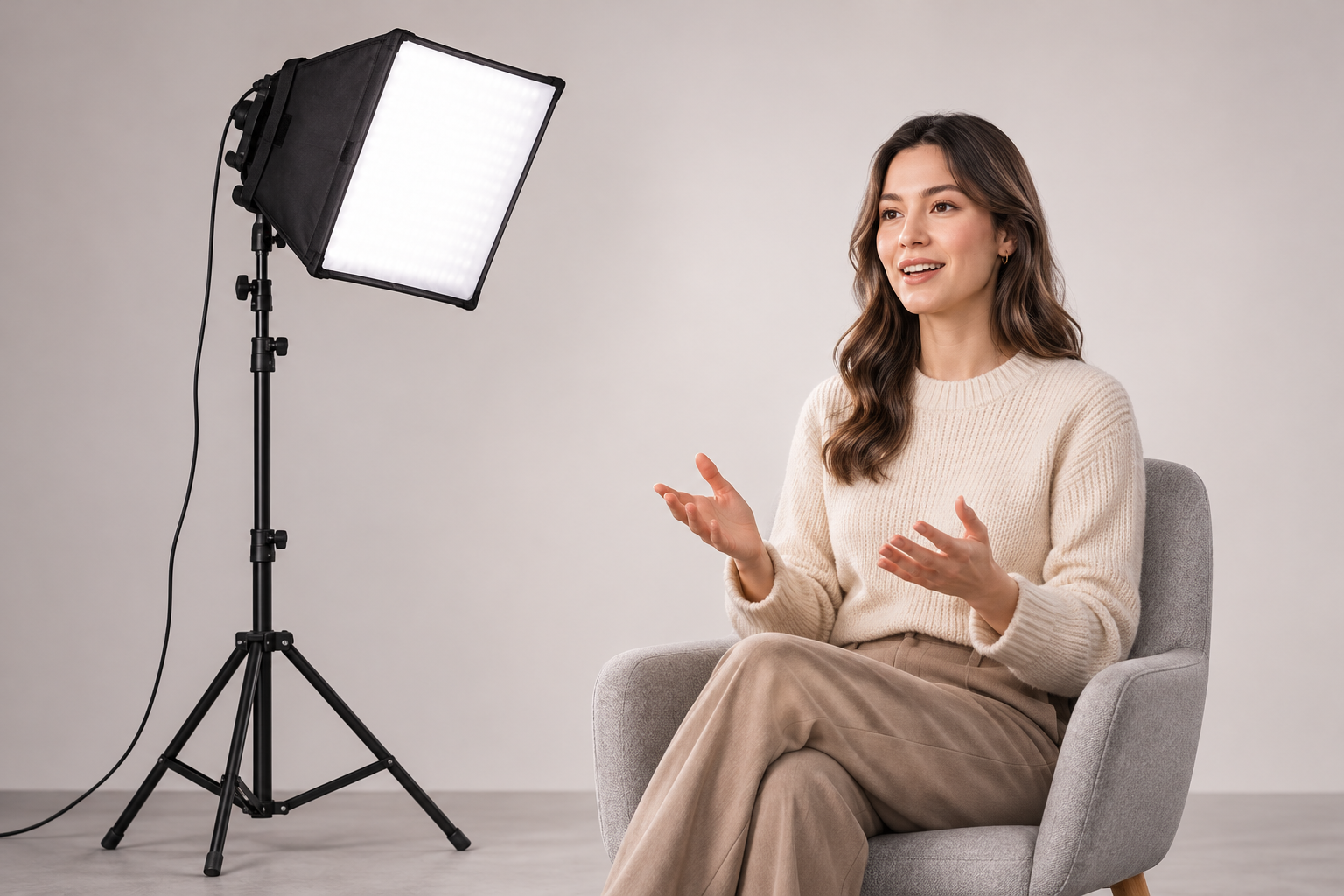
Panels use their own accessories. These are usually a clip-on softbox, a fabric grid and barn doors that fit that panel only. That is fine if the maker sells what you need. Check this before you buy. Our AMARAN Pano 60c has matching barn doors, for example.
Modifiers are not free. The amaran F22c help page lists 3,360 lux at 1 m bare and 2,048 lux at 1 m with its softbox at 5,600K. That is about 40% less light for softer shadows. Plan for it. Pick a light with more output than you think you need.
Use the right tool for each job:
- Softbox or dome: makes the source bigger, so shadows get softer.
- Fabric grid: narrows the beam and cuts spill, but does not make the source larger.
- Barn doors: flag light off a wall or a lens.
A common mistake is adding a grid and expecting softer light. A grid only adds direction. For a deeper look, see our guide to light modifiers for video.


Beam control: a worked example
Beam angle explains most of the brightness gaps you see on spec sheets.
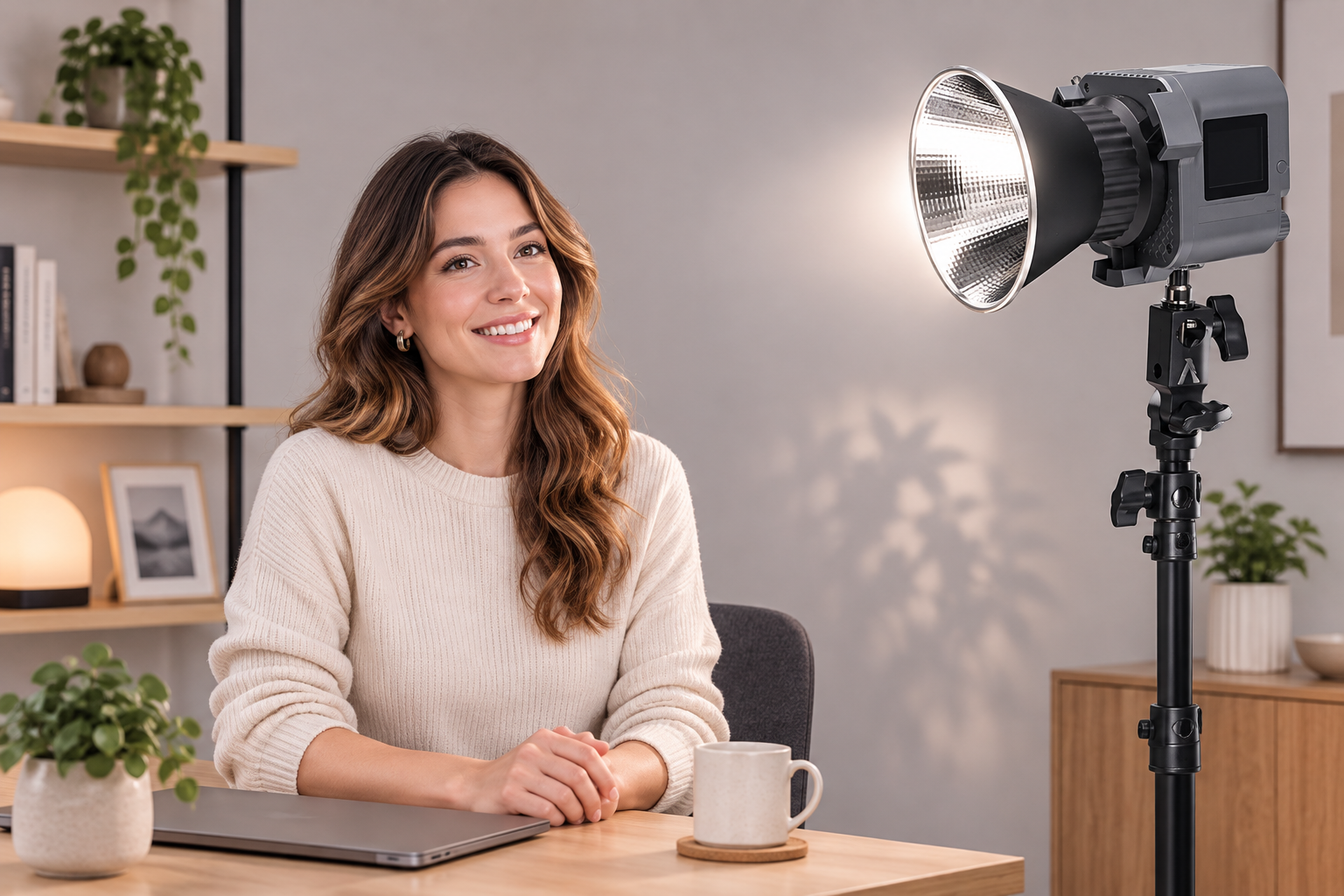
Take the amaran COB 60d S, a 65 W daylight COB light. The maker lists 2,940 lux at 1 m bare and 37,800 lux at 1 m with the Mini Hyper Reflector. At 3 m the same table gives 344 lux bare and 4,200 lux with the reflector.
| Distance | Bare | With Mini Hyper Reflector |
|---|---|---|
| 1 m | 2,940 lux | 37,800 lux |
| 3 m | 344 lux | 4,200 lux |
At 3 m, the reflector gives about 12 times more light. That is roughly 3.5 stops. The sibling COB 60x S narrows from 109.4° to 13.5° with the same reflector. So the light is not “stronger”. It is the same light squeezed into a tight spot.
A panel does the opposite. Its optics are fixed. The 60 W amaran P60c lists 5,900 lux at 1 m through a 45° beam. That is brighter than the bare COB at 1 m, because the panel’s beam is much narrower than a bare COB’s. But you cannot tighten it to 14° later.
How to use this:
- Subject 2–3 m away, dark room: use the reflector for punch, or a softbox if you want soft light and have output to spare.
- Wide fill or background wash: use a panel. Its fixed 45° spread is easier to place than a bare COB’s very wide beam.
- Hard sun-like accent through a window or door: use a COB light with a reflector or projection lens.
Panels with their own optics exist too. Aputure’s NOVA 9° 2×1 has a 9° native beam and 80° with its flat diffuser. So check the listed beam angle and modifier figures instead of guessing from the shape.
Colour quality and flicker: check the numbers
Package type does not give you good skin tones. These numbers do:
- CRI averages the colour shift of eight test samples. It hides the direction of the shift, as CIE describes.
- TLCI is the EBU’s method for video. It models a TV camera and display, so it fits our use better.
- TM-30 uses 99 samples and reports fidelity (Rf) and gamut (Rg), per the US Department of Energy.
- SSI is another spectral score that some makers publish. The COB 60d S lists SSI (D56) of 86+.
For example, amaran lists the COB 60d S at CRI 96+, TLCI 99+ and TM-30 Rf 96. Read how we use these scores in our guide to CRI and TLCI for video lights. If you mix lights on one set, use the same model and CCT setting for all of them.
Flicker is the other trap. Most LED lights dim with PWM, which switches the LEDs on and off very fast. A camera samples that, and rolling bands or strobing can show up in footage when timing does not line up. This happens with both COB and SMD lights.
So test before the shoot:
- Set the shutter speed and frame rate you will use.
- Dim the light to the level you will use. Dimming changes the PWM duty cycle, so a clean result at full power does not prove a clean result at 20%.
- Record 10 seconds and play it back full size.
Which one should you pick?
Use these rules.
Pick a COB light if:
- you want to use softboxes, domes or lanterns from other brands,
- you need to throw light 2–3 m or more,
- you want one defined shadow, or a hard accent,
- you plan to add a projection lens or reflector later.


Pick a panel if:
- the room is small and you need a wide, even wash,
- you shoot interviews or streams at 1–2 m,
- you want a slim light for a desk or a tight set,
- you do not want to buy extra modifiers.
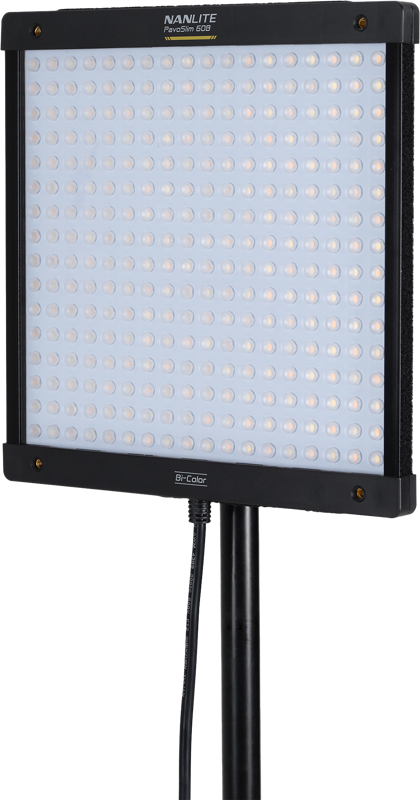

This advice changes at high power. A 600 W-class COB light and a large panel both need serious stands, cables and power. Our LED panels category shows what is in stock for the panel route. If you are unsure, ask us. We can match a light to your room size and camera.
Key Takeaways
- COB is one emitter, SMD is many. COB gives one shadow. Panels hide their many emitters behind diffusion.
- COB’s Bowens mount gives wider modifier choice. Panels depend on the maker’s own clip-ons.
- Beam angle explains the lux numbers. The COB 60d S gains about 12 times more light at 3 m with its reflector.
- Colour comes from the spectrum, not the package. Check TLCI and SSI, then test flicker at your shutter and frame rate.
- Plan for modifier loss. In the F22c figures, one softbox cut output by about 40%.
Not sure which light fits your set? Talk to the MediaGear team. Tell us your room size, camera and subject distance, and we will suggest a light and the right modifiers.


