





Flying With V-Mount Batteries: The 100Wh Rule Explained
Yes, you can fly with V-mount batteries. But the mount type does not matter. The watt-hour (Wh) rating decides everything. A V-mount battery is a lithium-ion battery, and airlines treat it like any other spare lithium-ion battery.
Here is the rule in one table. It follows the IATA and FAA passenger guidance, which most airlines follow. We checked the rules in October 2026.
| Battery rating | Spare in carry-on | Spare in checked bag | Limit per person |
|---|---|---|---|
| Up to 100Wh | Yes, no approval | No | Up to 20 spares (IATA) |
| 101–160Wh | Only with airline approval | No | 2 spares |
| Over 160Wh | No | No | Not allowed as passenger baggage |
Your airline can be stricter than this table. Always check its own page before you pack.
How to find your battery’s Wh rating
IATA says every lithium-ion battery must have its Wh rating printed on the outside of the case. If staff cannot verify the rating on the battery or in the user documents, the airline may refuse it. So never peel off or cover the label.
If the label is missing, calculate it. The FAA gives the formula: Wh = volts × amp-hours. If the battery shows mAh, divide by 1,000 first.
Two examples:
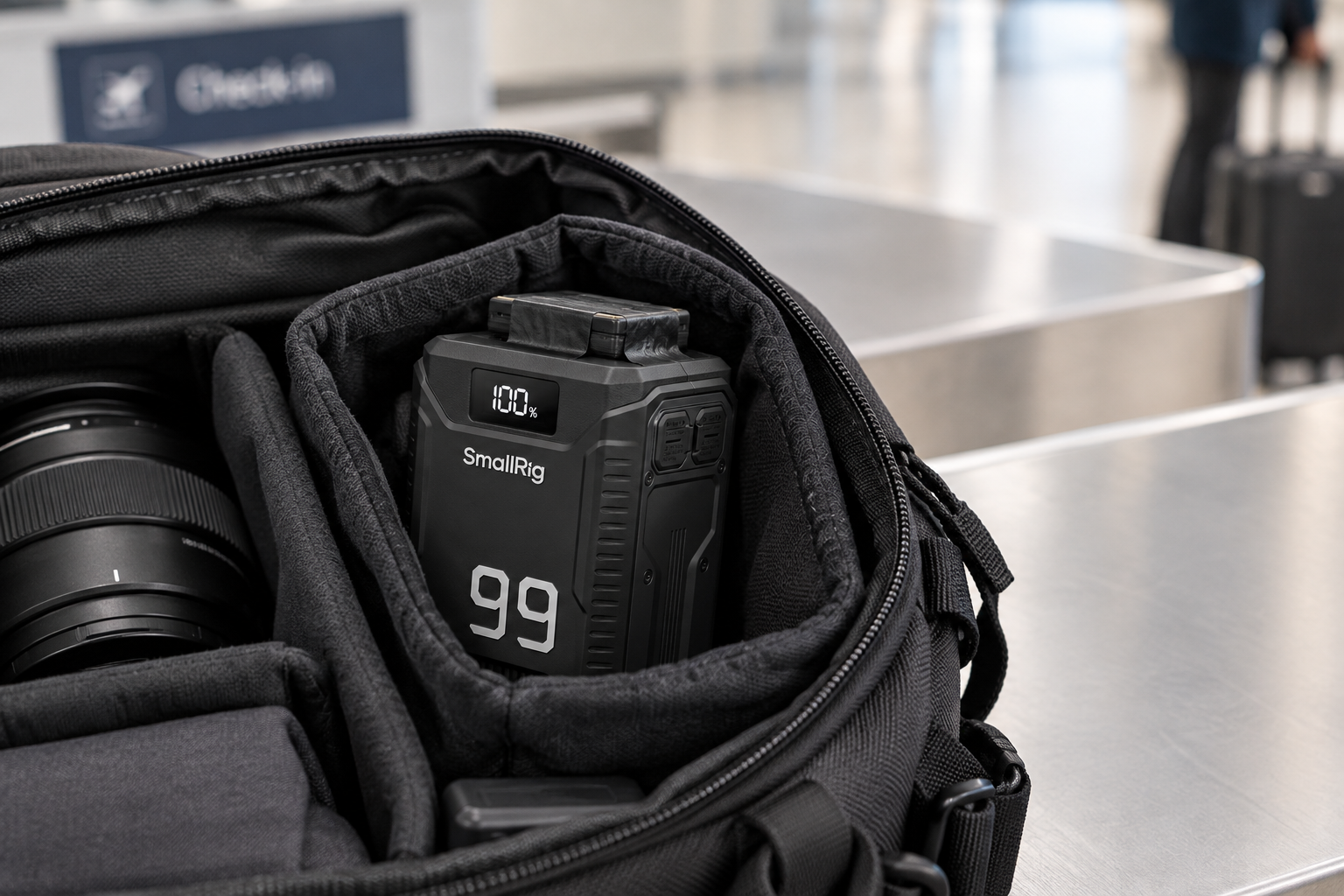
- 14.54V × 6.8Ah = 98.9Wh. This matches the SMALLRIG 5864 T99, which lists 98.872Wh. It is legal without approval.
- 14.4V × 13.2Ah = 190Wh. This matches a 190Wh V-mount pack. It is over 160Wh, so it cannot fly with you.
This is why so many travel-friendly V-mount batteries are rated 98Wh or 99Wh. They sit just under the 100Wh line.
Where the battery must go: carry-on only
Spare batteries are forbidden in checked baggage. IATA, the FAA and EASA all say the same. If a battery overheats in the hold, nobody can reach it. In the cabin, crew can react fast.
Three practical rules:
- Pack V-mount batteries in your carry-on. Treat a battery clipped on a camera rig as a spare too. Take it off the plate before you check the rig.
- Protect the terminals. IATA allows the original retail packaging, tape over the contacts, or a separate plastic bag or pouch for each battery. This stops a short circuit.
- Remove batteries if your bag is gate-checked. The FAA says spare batteries must come out of a carry-on that gets checked at the gate. Keep them with you in the cabin.
For a wider packing plan, read our guide on flying with video gear. If you are still choosing a bag, see hard cases versus soft cases.
Flying with a battery between 100 and 160Wh
Batteries such as 147Wh and 150Wh packs are allowed, but only with airline approval. You can carry at most two. This is the rule in the IATA passenger guidance and the FAA PackSafe rules.
Airlines handle this tier differently. These are the policies we found:
- Lufthansa: a maximum of two spare batteries up to 160Wh, and batteries over 100Wh need prior approval (conditions of carriage).
- Finnair: 100–160Wh spares need prior approval, with a maximum of two per person (Finnair FAQ).
- Ryanair: spare batteries must not exceed 100Wh each, and you can carry up to 20 (Ryanair help centre). A 150Wh battery will not work here.
- easyJet: its page lists two spare batteries of up to 160Wh each (easyJet dangerous goods). Confirm the approval step with them before you fly.
To get approval, contact the airline well before the trip. IATA says to be ready with the Wh rating, the number of batteries and whether each one is removable. For several spares, the airline may also ask for extra separation between batteries or a low state of charge (below 25%). Ask for the answer in writing and carry it with you. The sources do not require written proof, but it saves a long talk at the gate.
This gets messy if your trip has several flights on different airlines. One Ryanair leg rules out 150Wh packs for the whole trip. In that case, the simple choice is to travel with 98–99Wh batteries.
What about batteries over 160Wh?
Large packs of 184Wh, 190Wh, 221Wh or 270Wh cannot travel as passenger baggage. IATA says batteries over 160Wh must be prepared and carried as cargo under the Dangerous Goods Regulations. That is a job for a trained shipper, not a suitcase.
You have three realistic options:
- Use a dividable pack. The SWIT S-8192S splits into two 92Wh parts. MediaGear’s product page says each part is not restricted by air transport rules. Carry the two halves separately and join them on set. The pack costs €449 (€556.76 incl. VAT).
- Bring several small batteries. Four 98Wh packs give you 392Wh and stay legal in IATA terms. Some airlines set a lower cap on spares, so check the number.
- Source the big batteries at your destination. Rent or buy locally and avoid the shipping paperwork.
All lithium-ion batteries also need to pass the UN 38.3 test series before they are transported. Reputable brands do this, so ask for the test summary if you buy from an unknown seller.
Power bank rules now affect V-mount batteries too
Many V-mount batteries have USB-C outputs and are sold as power banks too. The SMALLRIG T99, for example, is listed as a “V-Mount Battery / Power Bank” with 100W USB-C output.
This matters because airline power bank rules are getting tighter:
- IATA’s power bank guidance says no more than two power banks per person, and no recharging on board.
- EASA says power banks must not be used to charge devices during the flight.
- Lufthansa Group allows two power banks in carry-on, and not in overhead bins.
The sources do not say if an airline counts a V-mount battery as a power bank. We suggest you act as if it does. Keep it in your under-seat bag, switch it off, and do not charge from it or charge it in flight. If you plan to carry more than two, ask the airline first.
V-mount batteries that suit air travel
If you fly often, pick packs at or below 98–99Wh. They need no approval with IATA-based airlines, and you can carry more than two. They are also the only option on airlines with a hard 100Wh cap.
- SMALLRIG 5864 T99 (98.872Wh). Weighs 862g, has IP54 protection and survives a 1.8m drop. It has two USB-C ports (100W max) and D-Tap outputs. It suits crews who want one rugged pack for camera and phone.
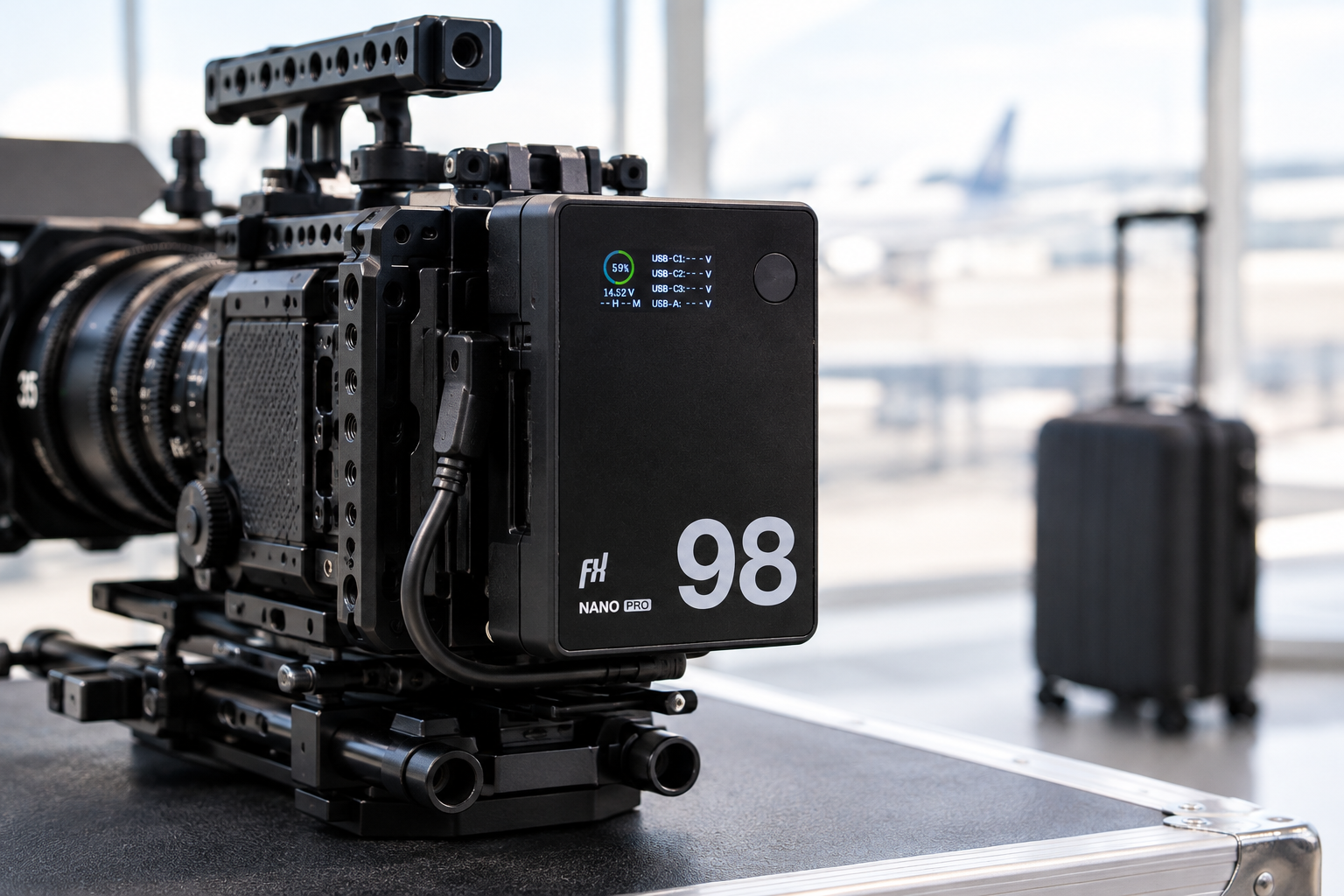
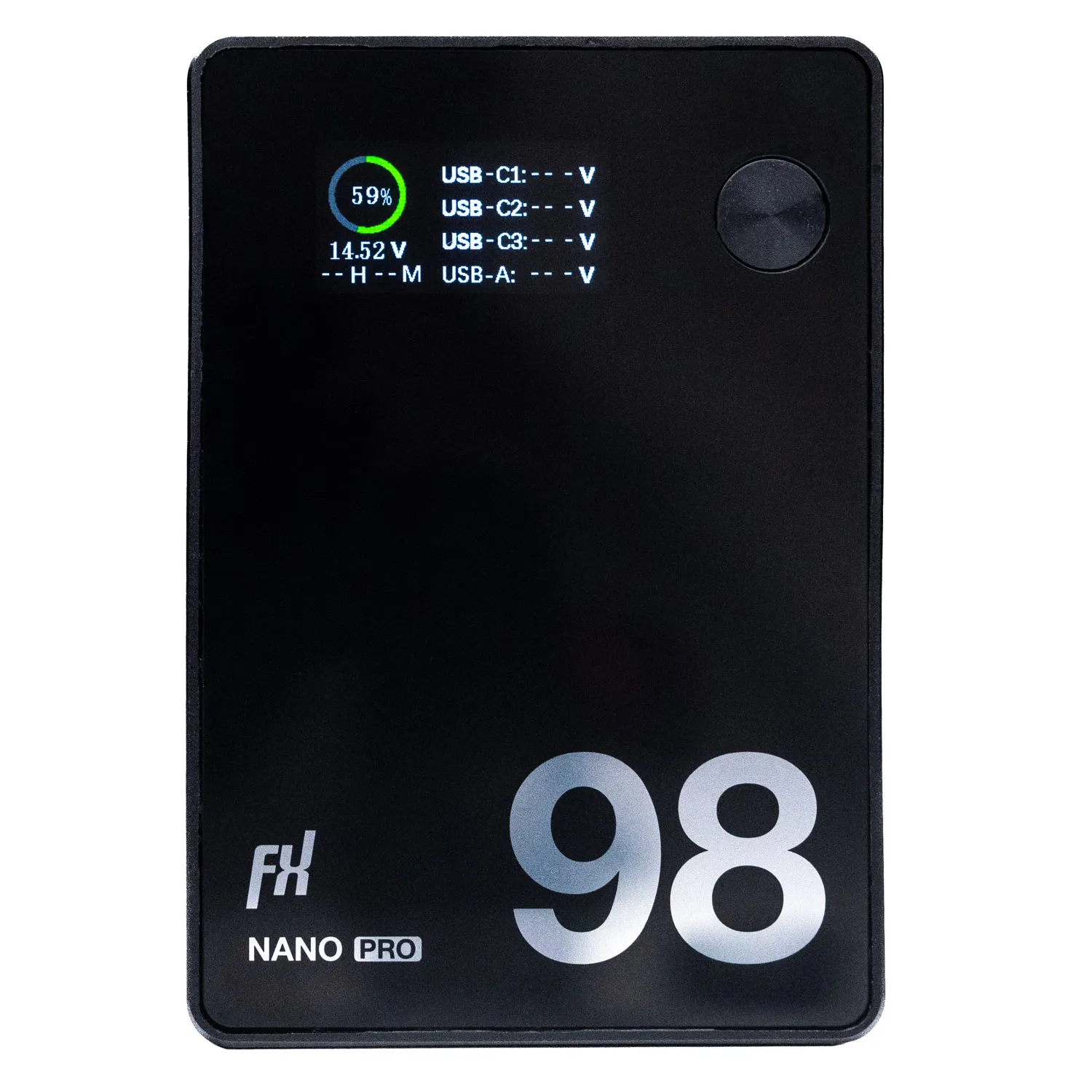
- FXLION Nano Pro 98Wh. Weighs 612g, delivers up to 156W (13A) and has a USB-C PD 100W port. It suits a small cinema rig or a gimbal. It is the lighter of the two.

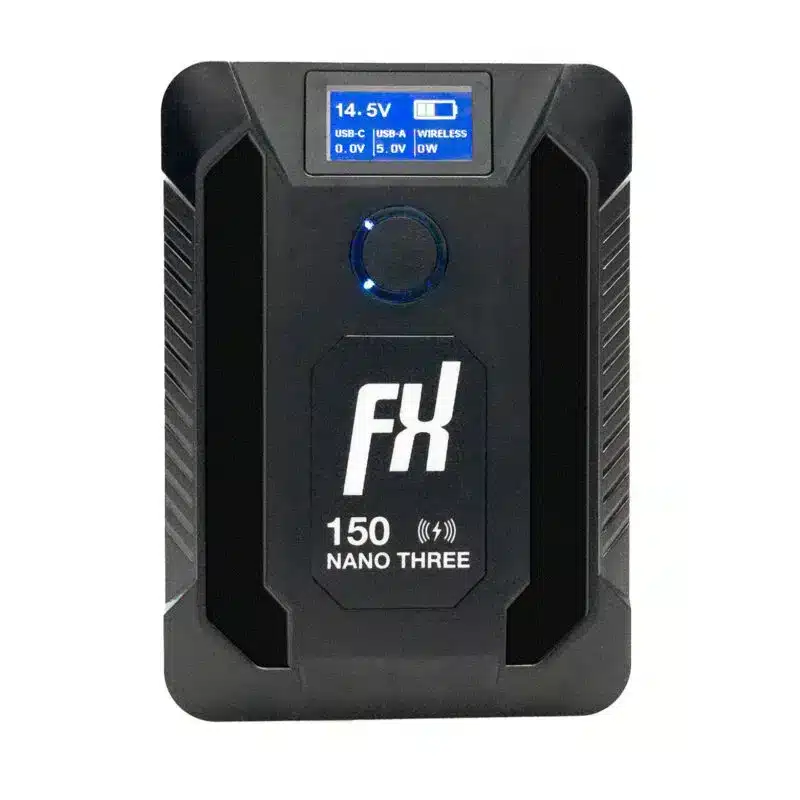
Need more runtime and fly with an airline that approves 100–160Wh? The FXLION Nano Three Wireless 150Wh stays under the 160Wh cap. You can carry two at most, and only with approval. It does not suit airlines like Ryanair.
Browse every option in our V-mount battery category. Our V-mount battery buying guide shows how to match Wh to your runtime needs. A multi-bay charger at your hotel also saves you from carrying extra packs.
Packing checklist before you leave home
- Calculate the Wh of each battery and confirm the label is readable.
- Check your airline’s own battery page for every flight leg.
- Ask for approval in advance for any battery over 100Wh.
- Tape the terminals or put each battery in its own pouch.
- Move all spare batteries into your carry-on. Remove them from rigs.
- Keep the batteries somewhere you can reach them, not in an overhead bin.
- Take the battery spec sheet with you in case staff question the label.
Key Takeaways
- V-mount batteries can fly. The Wh rating, not the mount, sets the rules.
- Up to 100Wh: carry-on only, no approval. 101–160Wh: airline approval and two spares. Over 160Wh: not allowed as passenger baggage.
- Never put spare batteries in checked baggage. Protect the terminals and keep the Wh label visible.
- Airlines differ. Ryanair caps spares at 100Wh, while Lufthansa and Finnair need approval for 100–160Wh.
- For regular travel, choose 98–99Wh packs, or a dividable pack if you need more capacity on location.
Planning a shoot abroad? Browse our V-mount batteries and pick packs that are ready for the cabin. Our team can also help you size a battery kit for your rig.


