





How to Calculate Battery Runtime for Video Gear
You can work out how long a battery will last with one line of maths. Divide the battery’s watt-hours (Wh) by the total watts your gear draws. Then multiply by 0.85 to allow for real-world losses.
Runtime in hours = battery Wh × 0.85 ÷ total watts
Here is the short version:
- Find the battery’s Wh rating. If it only shows Ah, multiply Ah by volts.
- Add up the watts of every device on that battery.
- Divide, then multiply by 0.85.
- Use a bigger safety margin in the cold, with old batteries and with power-hungry rigs.
The rest of this guide shows each step with real numbers, so you can plan a shoot before you leave the office.
Step 1: Find the battery’s watt-hours
Watt-hours tell you how much energy a battery holds. This is the number you need. Amp-hours (Ah) and milliamp-hours (mAh) are not enough on their own, because they ignore voltage.
Most V-mount batteries print the Wh rating on the case. If yours only shows Ah, use this formula:
Wh = Ah × volts
For example, one 14.4 V V-mount pack is rated 6.8 Ah. That gives 6.8 × 14.4 = 97.9 Wh, and the maker sells it as a 98 Wh battery. For small cells in mAh, divide by 1,000 first.
Always use the nominal voltage from the label. V-mount packs are usually rated 14.4 V or 14.8 V. Packs sold as 98 or 99 Wh sit just under the 100 Wh air travel limit. We cover that later in this guide.
Step 2: Add up what your rig draws
Every device on the battery adds to the total. Take the wattage from the manufacturer’s spec sheet, not from a forum post. Look for the figure given for recording, not for standby.
Here are some published figures:
| Device | Power draw | Source |
|---|---|---|
| Sony FX3 (recording movies, with lens) | about 7.3 W | Sony specs |
| Sony FX6 (XAVC-I QFHD 59.94p, viewfinder on, nothing connected) | about 18 W | Sony specs |
| ARRI ALEXA Mini (body with MVF-1) | 43 to 84 W | ARRI |
| ARRI ALEXA Mini LF (ARRIRAW 24 fps, MVF-2) | about 65 W | ARRI FAQ |
| Hollyland Mars 4K transmitter / receiver | under 8.5 W / under 5 W (typical) | Hollyland |
| Atomos Ninja recorder | 10 to 22 W | Atomos |
Look closely at the FX6 line. Sony lists 18 W for the bare camera. In the same manual, it lists about 36 W when the camera records at 120 fps with HDMI, SDI and an external device connected. The same body can draw double.
So write down every accessory. Monitors, wireless video, follow-focus motors and recorders all count. Some devices only list a maximum. If so, use the maximum as a safe estimate.
Step 3: Divide, then apply the 0.85 factor
The simple answer is Wh ÷ W. It gives you the best case. Voltage conversion in plates, cables and dummy batteries wastes some energy, and the battery never delivers 100% of its rating.
Many runtime tools use about 0.85 for these losses. One planner uses a 90% factor for DC-DC converters and a separate 80% limit to protect battery health. Treat 0.85 as a planning figure, not a promise. It is a sensible default.
Worked example: a run-and-gun rig
Say you shoot with a Sony FX6, a Hollyland Mars 4K transmitter and an Atomos Ninja. You power everything from one 99 Wh V-mount battery.
- Camera: 18 W
- Wireless transmitter: 8.5 W
- Recorder: 10 W (the low end of Atomos’ range)
- Total: 36.5 W
The best case is 99 ÷ 36.5 = 2.7 hours. With the 0.85 factor, it is 2.7 × 0.85 = 2.3 hours. That is about 2 hours 18 minutes. You should plan on two hours per battery, not three.
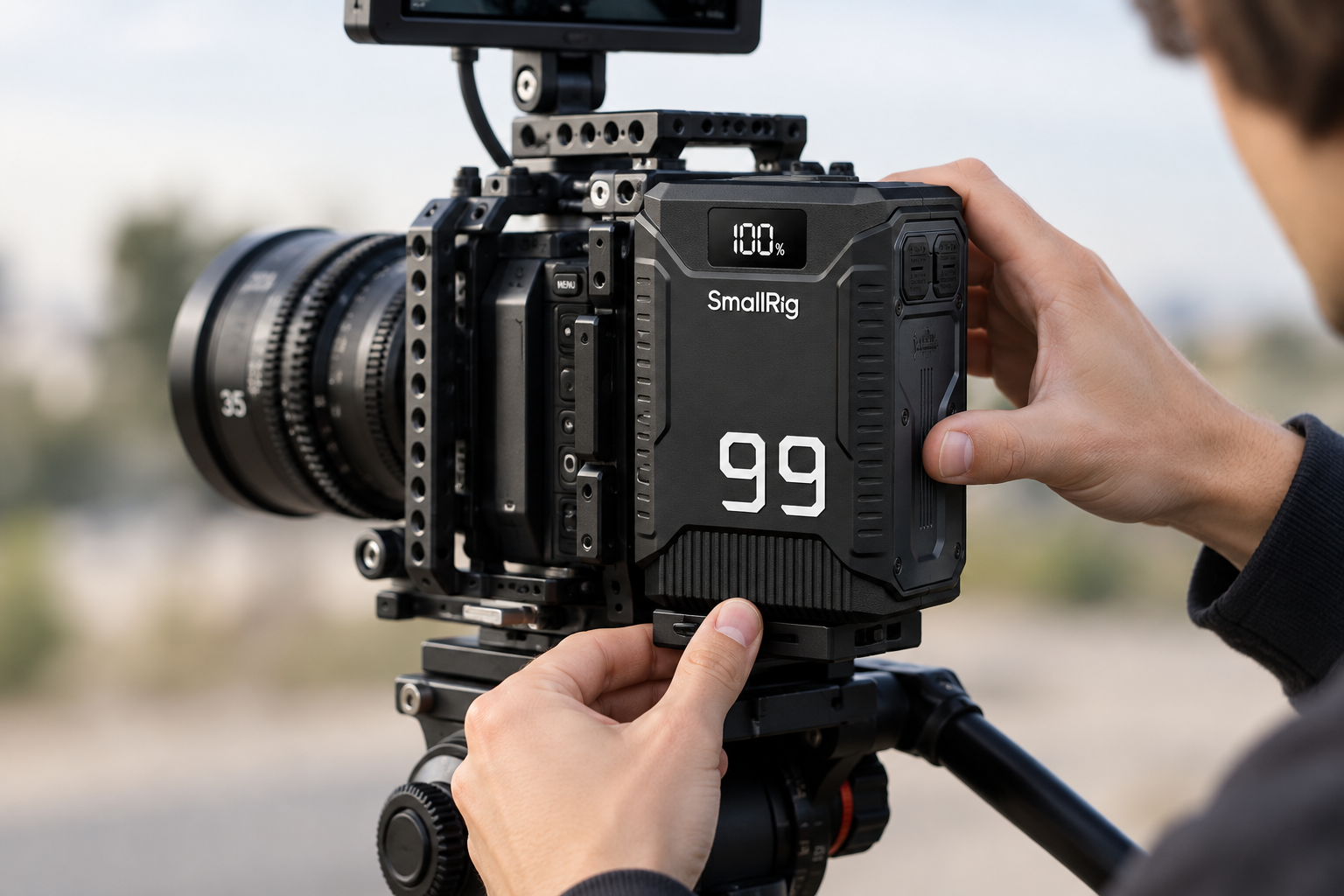
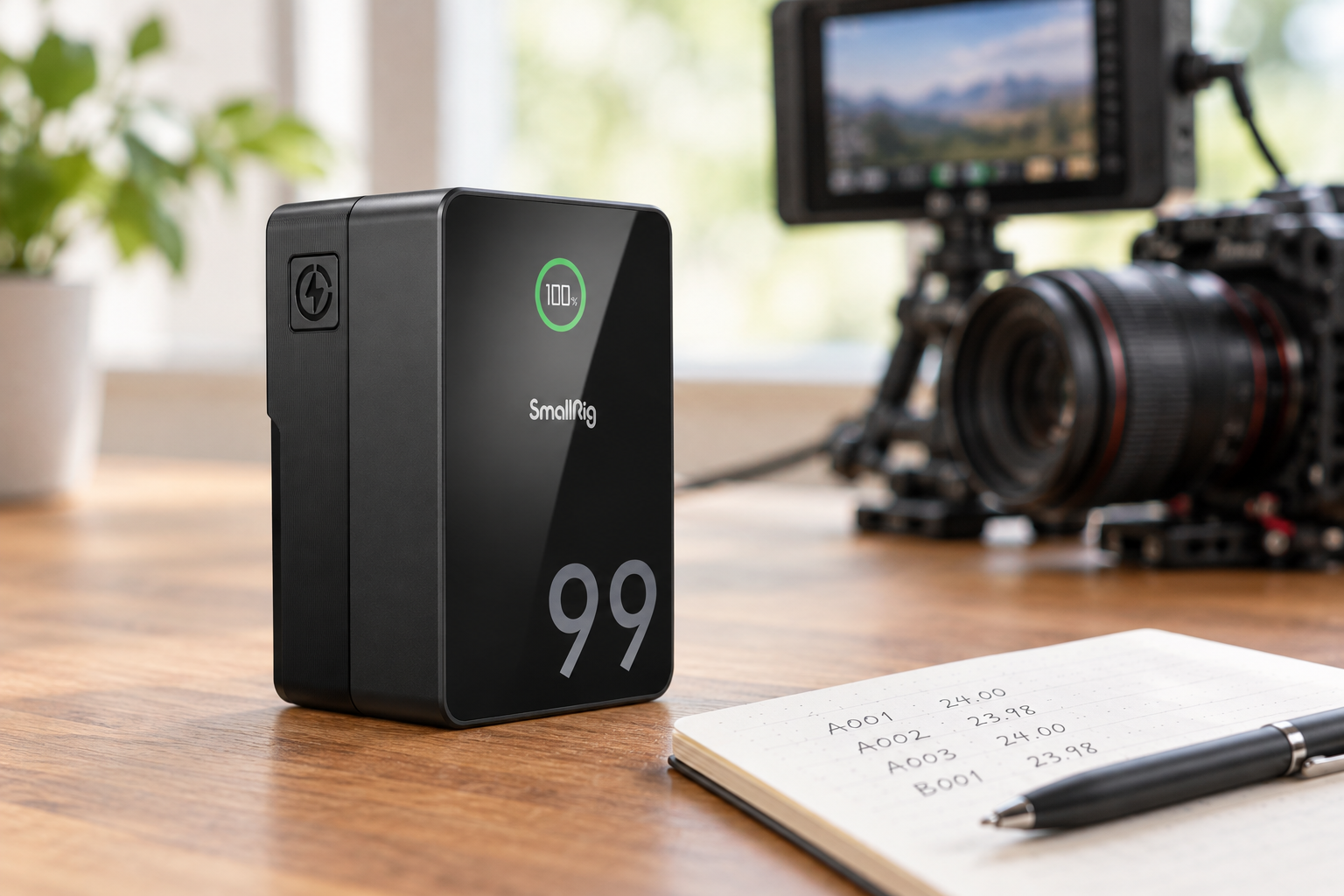
A compact 99 Wh pack suits this kind of rig well. The SmallRig T99 V-mount battery is one option. It stays under the airline limit. It does not suit you if your rig draws over 60 W. At that load it lasts about 1 hour 25 minutes (99 × 0.85 ÷ 60).

Check the method against a real spec
We can test the 0.85 factor against Sony’s own numbers. The FX6 manual says about 215 minutes of recording with a BP-U70 battery, under the 18 W test conditions. The BP-U70 is rated at 72 Wh.
The best case is 72 ÷ 18 = 4.0 hours, or 240 minutes. Sony’s 215 minutes is about 90% of that. So 0.85 is slightly cautious, which is what you want for planning.
What shortens your runtime
The formula assumes fixed power draw and a healthy battery. On a real shoot, several things break those assumptions.
Cold weather. Cold slows the chemical reactions inside lithium-ion cells. Axis notes this leads to shorter operating time. It also warns that charging below 0 °C can cause severe, permanent capacity loss. Sony rates the BP-U70 to discharge from -20 °C to +45 °C, but to charge only at 0 °C to 40 °C. Published tests show very different losses, so we can’t give one number. As a safe rule, plan on half the rated capacity in freezing conditions. Keep spare batteries inside your jacket and charge them indoors.
Battery age. A battery with many cycles holds less than its label says. Work out a real figure by running the battery down in a test. Then use your own number in the formula.
Changing modes. High frame rates, external recording and bright viewfinders all raise the draw. Use the highest-draw mode you will use for the calculation.
Lights on the same battery. LED lights draw far more than cameras. If a light shares the battery, add its draw at the brightness you will use. Many fixtures only list a maximum. Check the manual for the draw at your dimmer setting.
Check that the battery can deliver the load
Capacity is only half the story. The battery also has to supply enough current at once. Typical 98 Wh V-mount packs are rated for a 12 A maximum draw. At 14.4 V, that is about 173 W. Large cinema rigs can go past that limit with lights and motors.
Small accessory ports are more limited. A D-Tap cable that drops the voltage to 12 V may be rated for only a 25 W load. Going over it can destroy the cable. The same rule applies to a plate with several outputs. Our guide on powering multiple devices from one battery explains how to size the load with a 70% rule.
Plan for the flight limit
If you fly with your gear, the Wh rating affects what you can carry. IATA says lithium-ion batteries up to 100 Wh are generally allowed in carry-on bags. Batteries of 100 to 160 Wh may be allowed with airline approval. EASA adds that spare batteries must not travel in checked baggage and must be protected against short circuits. Our guide to flying with video gear covers the packing details.
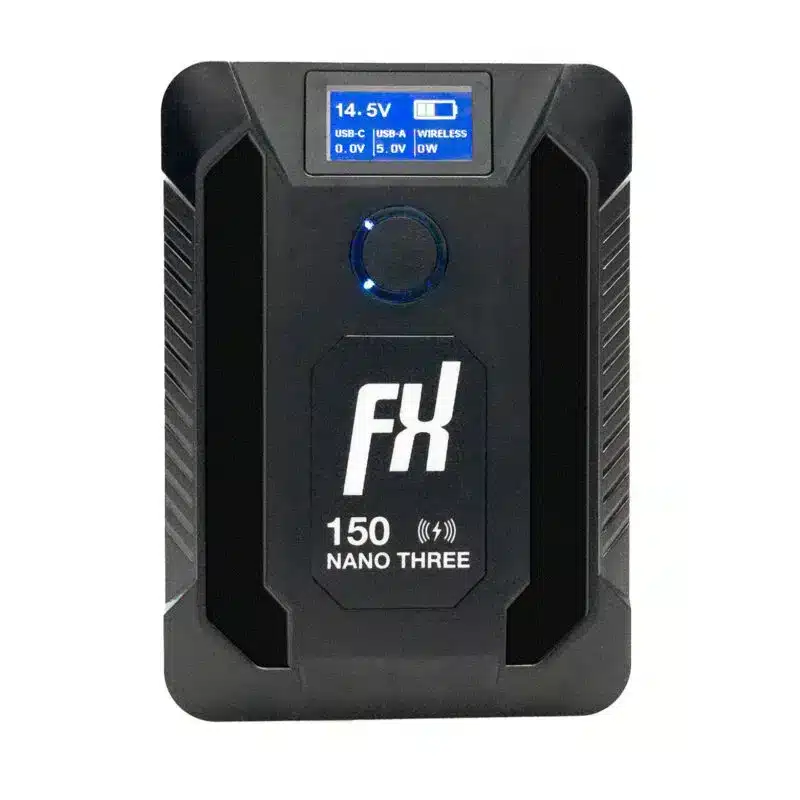
This is why many crews carry several 98 or 99 Wh batteries instead of one big one. If your rig needs a longer run time and your airline approves, a 150 Wh pack gives you 50% more energy per battery. The FXLION Nano Three 150 Wh is a compact example. Confirm the approval with your airline before you travel.
Key Takeaways
- Runtime in hours = battery Wh × 0.85 ÷ total watts. Convert Ah to Wh by multiplying by the nominal voltage.
- Take wattage from spec sheets, and use the highest-draw mode you will actually shoot in. The FX6’s draw doubles with high frame rates and external devices.
- A 99 Wh battery on a 36.5 W rig lasts about 2 hours 18 minutes, not 2.7 hours.
- Plan extra margin in the cold, and never charge batteries below 0 °C.
- Check the battery’s current limit and your adapters’ wattage ratings, not just capacity.
Ready to size your power kit? Browse our V-mount batteries and Gold-mount batteries. If you can’t decide, send us your camera and accessory list. We’ll help you work out how many batteries you need. You can also read our V-mount battery guide to compare capacities from 50 Wh to 300 Wh.


