





Tube Light vs LED Panel for Video: Which to Buy First
Buy an LED panel first. Add a tube light second. A panel gives you enough output to light a face, so it works as a key or fill light. A tube is a long, thin accent: it suits rim light, background colour and lights you show on camera.
Here is the short version:
| Tube light | LED panel | |
|---|---|---|
| Best job | Rim light, background accent, visible practical | Key light, fill light |
| Shape of light | Long and thin: soft one way, harder the other | Wide and flat: soft in both directions |
| Output (examples) | amaran T2c: 475+ lux at 1 m. amaran T4c: 744+ lux at 1 m | amaran Pano 60c: about 6,290 lux at 1 m without a modifier |
| Fits in tight spots | Yes | Less so |
| Main weakness | Too dim to key a subject across a room | Bigger and more obvious in frame |
The rest of this guide explains why, with numbers you can check.
Why the shape of the light matters
Softness depends on how big the light looks from where your subject sits. A larger source gives softer shadows. A smaller source gives harder ones. Moving the light closer makes it look larger, as Canon’s lighting basics explain.
This is where tubes and panels differ.
- A panel spreads its LEDs over a flat surface. It looks large from the subject’s side in both directions. Shadows are soft all round.
- A tube is long but narrow. The amaran T4c is 120 cm long and about 4.2 cm wide. Along its length the light wraps nicely. Across its width it behaves like a small source. One comparison of tubes and panels notes this: a hard edge on one axis, a soft one on the other.
So “tube lights are soft” is only half true. They look soft when you put them very close. For a face, you usually want soft light in every direction, and that is the panel’s strength.
When a tube light is the right choice
Tubes solve problems a panel cannot. Use one when you need to:
- Separate the subject from the background. Put the tube behind and slightly above the subject. It traces an edge of light along hair and shoulders. Because a tube is slim, it also works where there is little room behind the subject.
- Add a colour accent. Tubes are widely used for background colour along a wall or the edge of a set.
- Show a light on camera. A tube looks like a believable practical light, such as a fluorescent fitting or a neon strip.
- Hide a light in a tight space. A 60 cm tube fits where a panel and stand would not.
The limit is output. The amaran T2c gives 475+ lux at 1 m (20 W). The T4c gives 744+ lux at 1 m (40 W). Both are rated CRI 95+ and TLCI 98+, so colour is accurate. Both fall well short of a key light. A Fstoppers review of a similar 746 lux tube calls it “an accent, a practical, or a very close soft source” that “will never key a subject across a room”. We agree with that for interviews.
Runtime also matters. Aputure rates the T2c at up to 2 hours at maximum output on its battery grip, and the T4c at about 100 minutes. Run a tube at 30–50% as an accent and it lasts much longer.


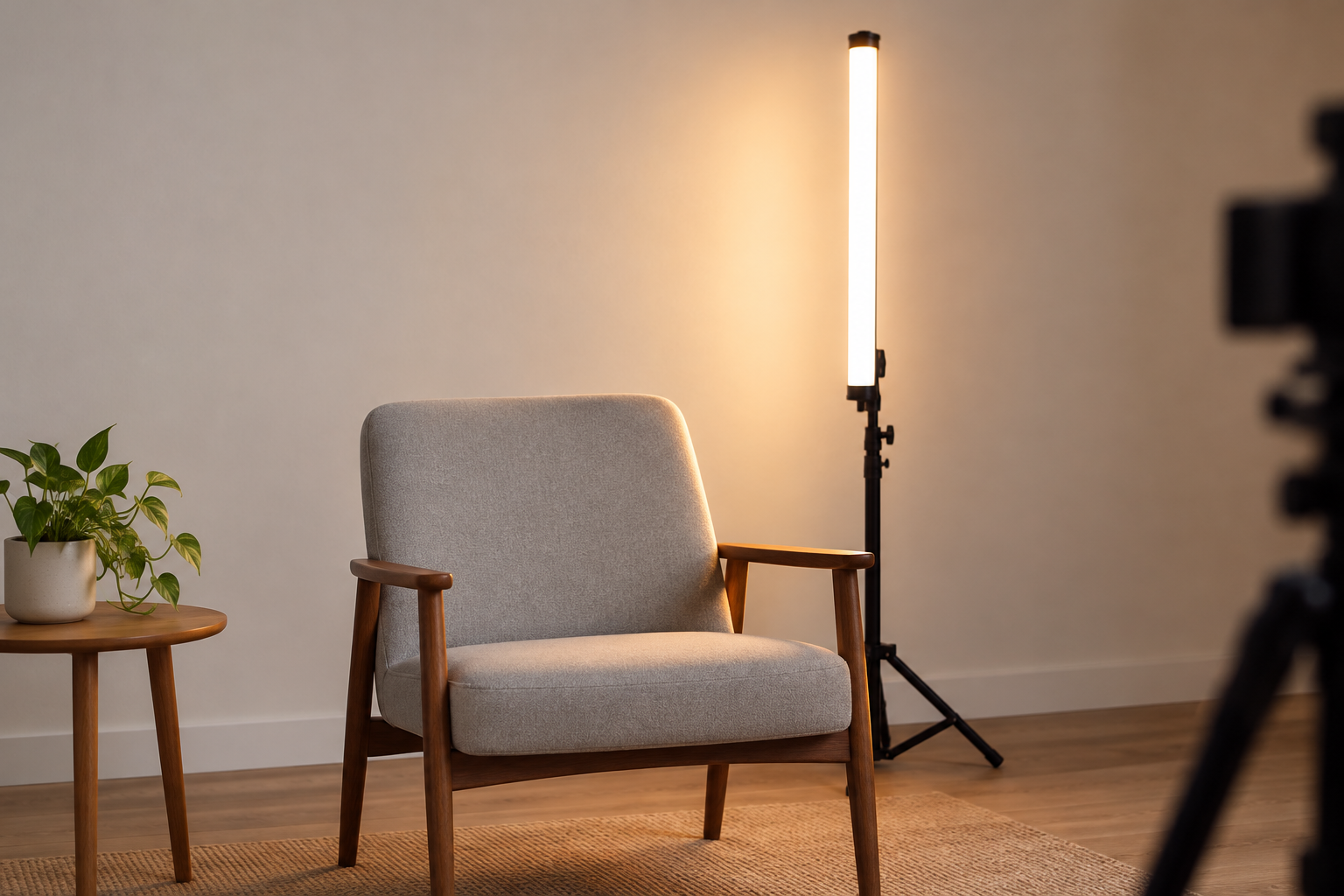
Browse more options in our tube and ring lights category. If you mount tubes on stands, check the clamp and adapter before you buy. For example, the amaran tubes have their own baby pin adapter for a 3/8 in screw.
When an LED panel is the right choice
Choose a panel when the light has to expose a person. It has more output, a wider face to work with, and it takes a softbox or diffuser.
Compare the numbers. The amaran Pano 60c measures 25.5 × 15.5 × 3 cm and weighs 610 g. Aputure’s specification page lists it at 6,290 lux at 1 m at 5,600 K with no accessory. That is more than eight times the T4c’s 744 lux. These are makers’ figures, measured their own way, so treat the ratio as a guide, not a lab result.
Diffusion costs light, and you should plan for it. Aputure’s own table shows the Pano 60c at 2,300 K giving 19,240 lux at 0.5 m bare, and 6,210 lux with the softbox. That is about two thirds lost, in return for a much softer look. Even so, it is still far more light than a tube gives at the same distance.
Panels also keep colour accurate. The Pano 60c is rated CRI 96 and TLCI 97, with a 2,300–10,000 K range. The European Broadcasting Union created TLCI to judge light as a camera sees it, and a score of 85 or more is generally treated as broadcast quality.
Power is simple on small panels. The Pano 60c runs from USB-C PD. Use a power bank rated at least 36 W, or a 65 W USB-C PD adapter. If your supply cannot deliver full power, the light caps its brightness and shows a warning. Bigger panels, like the 300 W Aputure Nova P300c at up to 9,000 lux at 1 m, need mains or a heavier battery.

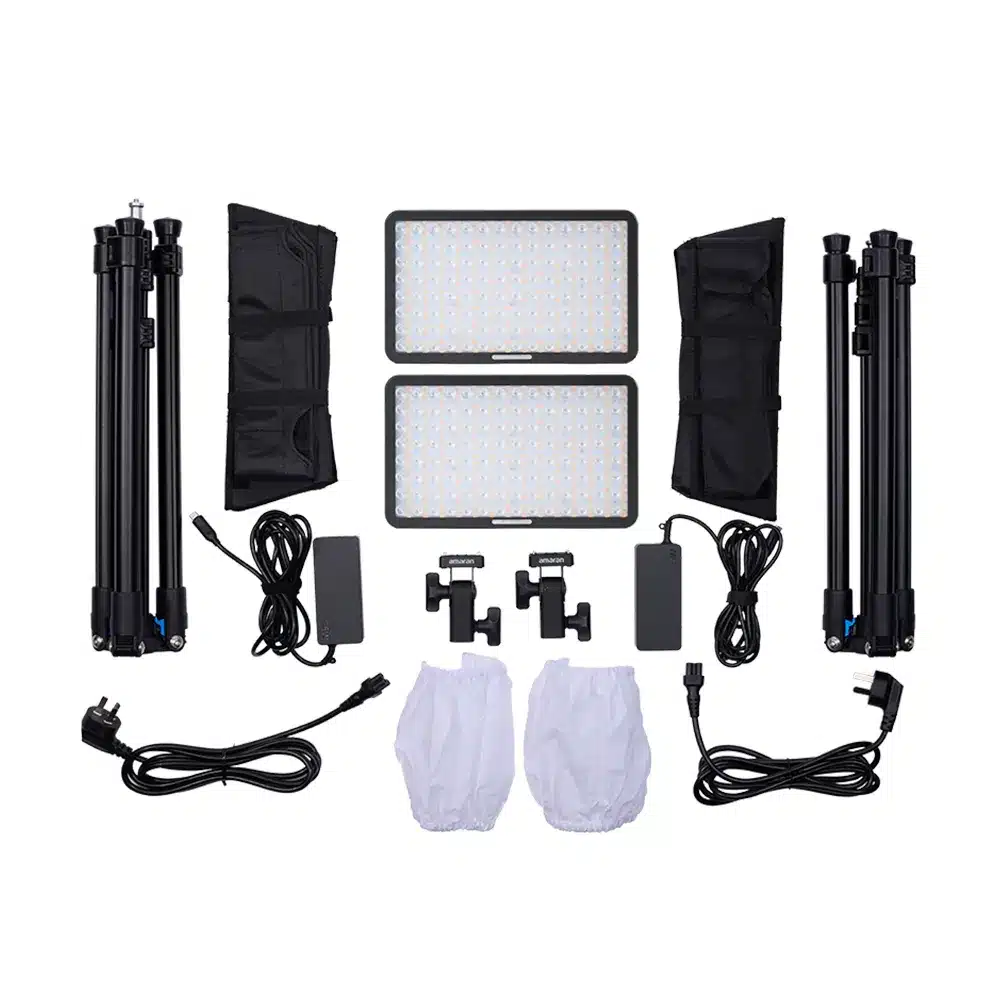
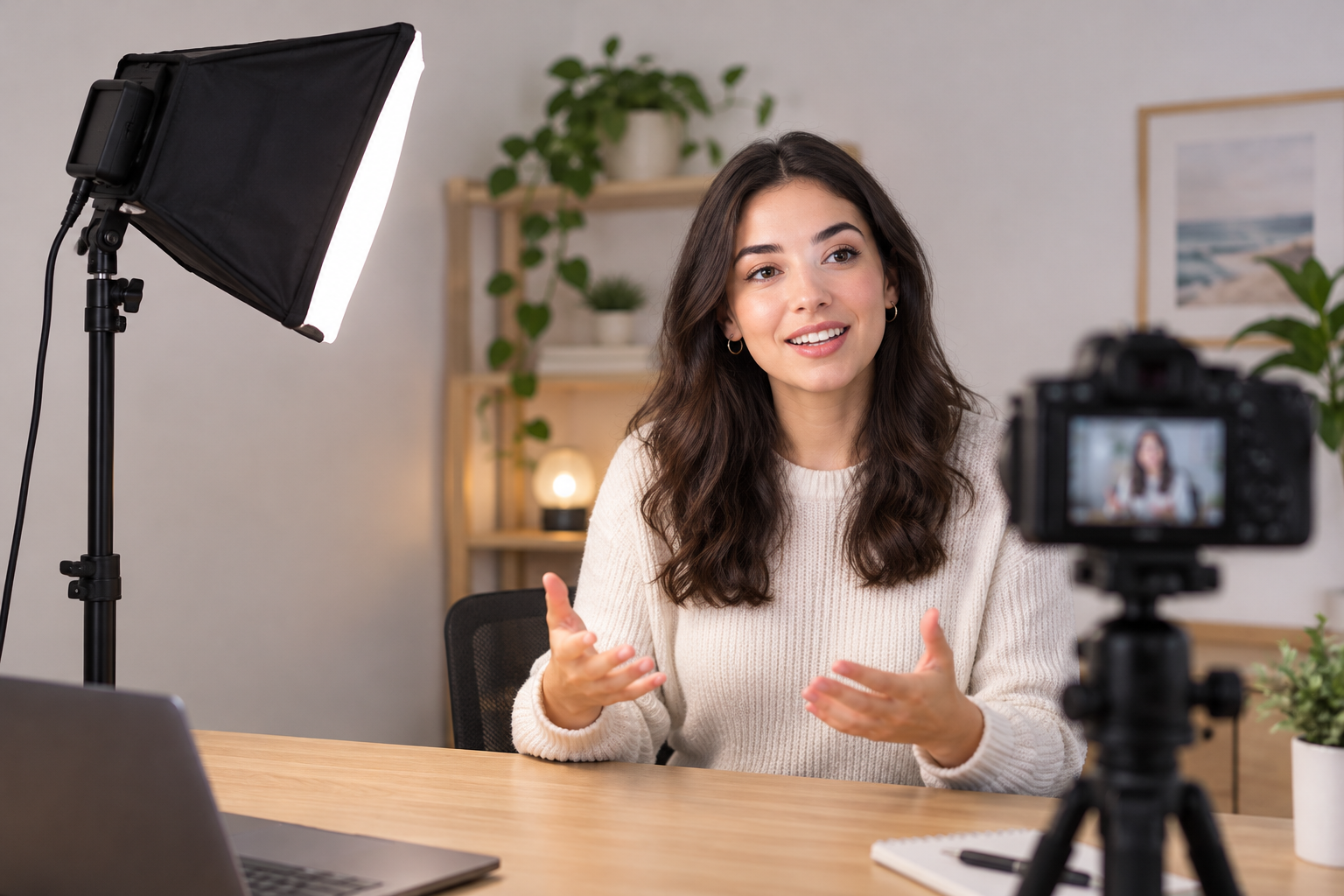
See the full range in our LED panels category. If you want a broader view of how panels compare with other fixtures, read our guide to LED panels vs Fresnels.
A worked example: lighting one interview
Say you film a seated speaker and want the key about 2 m from their face. How far does the light fall off?
Light falls with the square of distance. Double the distance and you get one quarter of the light, according to the American Society of Cinematographers. The same source says falloff from soft sources is less steep, so this is a cautious estimate.
- amaran T4c at 2 m: 744 lux at 1 m becomes about 186 lux.
- amaran Pano 60c at 2 m: 6,290 lux at 1 m becomes about 1,570 lux.
The panel at 2 m still gives about twice what the tube gives at 1 m. Add a softbox and you lose about two thirds, leaving roughly 500 lux. That still beats the bare tube at 2 m by a wide margin, and the light is softer.
Now the tube has a job: place the T2c or T4c behind the speaker as a rim light. Keep it at low power. It only has to draw an edge, not expose a face. For key, fill and back light positions, see our guide to three-point lighting for video and how to light an interview.
How to choose: simple rules
Use these checks before you buy.
- One light only? Buy a panel. It can act as key, fill or both.
- Need to light a person more than 1.5 m away? Panel. A tube will struggle.
- Already have a key and fill, and the background looks flat? Add a tube behind the subject or along the wall.
- Want a light visible in frame? Tube. It looks like a real fixture.
- Shooting solo on the move? A compact panel like the Pano 60c (610 g, USB-C power) packs small and runs from a power bank.
- Mixing the two? Match colour temperature. If a tube is 5,600 K and your panel is 3,200 K, skin and background will drift apart. Our colour temperature guide shows how to match them.
Two mistakes we would help you avoid. First, buying a tube as the only light for talking-head video. It looks cool in photos but leaves the face dim. Second, comparing lux figures without checking distance, because makers quote 0.5 m, 1 m or 3 m. Compare at the same distance and the same colour temperature.
Check spec sheets for CRI and TLCI too. Aim for CRI 95 or more and TLCI 85 or more. The amaran models in this article all list higher.
Key Takeaways
- A panel is the safer first light: more output, soft light in every direction, and it takes a softbox.
- A tube is an accent tool: rim light, background colour and visible practicals.
- Official figures show the gap: 744+ lux at 1 m for the amaran T4c versus about 6,290 lux for the Pano 60c.
- Distance matters more than most people expect. Double it and you get a quarter of the light.
- Many kits use both: panel for the face, tube for separation and mood.
Not sure which fits your room and budget? Browse our LED panels and tube lights, or contact the MediaGear team and we will help you pick a setup for your space.


